
Our first duty is to do no harm

Dr Ashendu Pandey
Chief Executive Officer, RAK Hospital
Health and the environment are inseparable. Heat, air quality and water scarcity already shape the health of the communities we serve, and healthcare itself carries a measurable environmental footprint.
Patient safety comes first. No sustainability measure will be adopted that compromises the quality or safety of care, infection prevention and control, or regulatory compliance.
As a hospital, our first duty is to do no harm. Today, that duty extends to the environment in which our patients live.
At RAK Hospital, we treat sustainability as part of safe, high-quality care, not as a separate initiative. This report sets out what we have done, how we measure it and where we are going next in compliance with all applicable federal and Ras Al Khaimah laws and regulations on climate, environment, waste and buildings, and we review this commitment as those requirements evolve.
I thank our staff, whose everyday choices turn these commitments into results, and our patients and partners for joining us on this journey.
Our planet, our health
The climate crisis is a health crisis. Rising temperatures, extreme weather, polluted air and pressure on water and food systems affect health everywhere, and the most vulnerable are affected first.
Additional deaths per year expected from climate change between 2030 and 2050, from undernutrition, malaria, diarrhoea and heat stress alone
Estimated direct damage costs to health each year by 2030
Source: World Health Organization, Climate change and health fact sheet.
How a changing climate affects health
Extreme heat
Extreme high temperatures contribute directly to deaths from cardiovascular and respiratory disease, particularly among older people.
Air quality
Higher temperatures raise levels of ozone and other air pollutants that worsen cardiovascular and respiratory disease.
Water security
A lack of safe water compromises hygiene and increases the risk of diarrhoeal disease.
Extreme weather
Weather-related disasters cause injury and loss of life, and disrupt the health services communities depend on.
Source: World Health Organization, Climate change and health.
Healthcare is part of the problem, and part of the solution
Hospitals operate 24 hours a day, depending continuously on energy, cooling, water, medical supplies and transport.
Estimated share of global net greenhouse gas emissions attributable to the health sector
Sources: Health Care Without Harm and Arup, Health care’s climate footprint.
What sustainability means to us
Using our resources wisely today, so that future generations continue to benefit from quality healthcare and a healthy environment.
- Safe, evidence-based care that avoids harm and unnecessary use of resources
- Using energy and water responsibly
- Reducing plastics, paper and avoidable waste
- Responsible choices in what we buy and how we build
- A culture in which every member of staff plays a role
- Partnerships that extend our positive impact beyond our walls
Six pillars on a shared foundation
Global health impact
Partnerships, education and resilience that extend our impact beyond our walls.
Aligned with
- UAE Net Zero by 2050 strategic initiative
- RAK Integrated Sustainability (RIS Strategy 2050).
- WHO guidance on climate-resilient, low-carbon health systems
Measurable progress in 2025
Electricity consumption versus 2024
Water consumption versus 2024
Recycling rate, up from 2.50% in 2024
Waste recycled
Annual spend on bags after the switch from plastic to paper
Sustainable vendors added
Comparisons are for calendar year 2025 versus 2024.
Sustainable inpatient room upgrade

Improving room comfort while reducing the resource intensity of hospital operations.
01High-efficiency cooling
Upgraded inpatient-room cooling supported by optimised chilled-water operation.
Lower electricity demand02Chilled-water optimisation
Cooling-system optimisation can improve energy performance and reduce operating load.
Efficient HVAC performance03Water pressure regulation
Pressure regulation supports controlled water flow and helps limit unnecessary water use.
Water conservation04Smarter operations
Monitoring, preventive maintenance and efficient controls help sustain energy and water performance.
Continuous improvementUsing energy intelligently
Cooling is one of the largest energy demands of any hospital in our climate. We focus our efforts where the impact is greatest.
718,683 kWh saved in 2025
5,447,217 kWh in 2025, down from 6,165,900 kWh in 2024
What we did
- Wet wall system on air-cooled chillers
- Chiller management adapting to ambient temperature
- AHU cooling coils replaced for higher efficiency
- Energy-efficient LED lighting
- Free cooling in non-clinical areas in winter
- VRF and inverter air-conditioning units
- Sensors and timers
- Consumption monitoring and responsible use

Energy conservation

Annual achievement
Environmental & social value
Our hospital is making a difference
Saving energy. Reducing emissions. Caring for people and the planet.

Every drop counts
In one of the most water-scarce regions of the world, responsible water use is part of our duty to the community.
2,021 m³ saved in 2025
Consumed in 2025, down from 50,459 m³ in 2024
What drove the improvement

More waste recovered for recycling
Waste recycled
Recycling rate in 2025, up from 2.50% in 2024
Recycled waste (kg)
Key initiatives
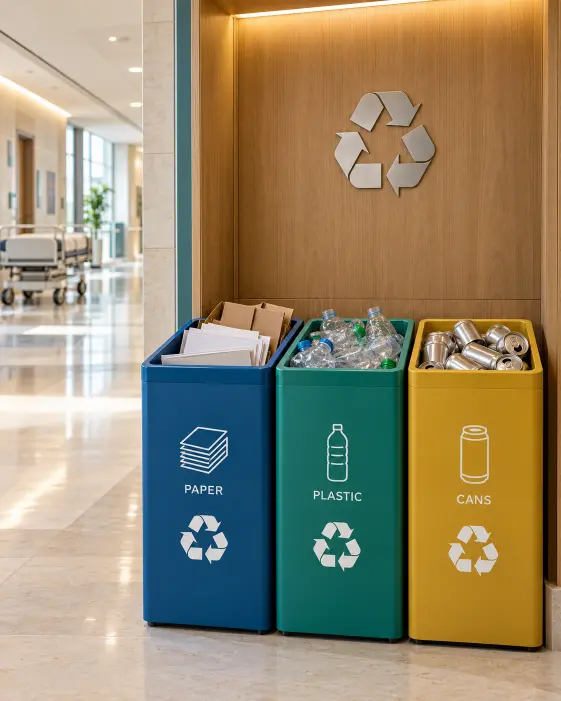
From plastic to paper bags
We have been reducing our dependence on plastic by moving to recyclable paper bags, while improving procurement cost efficiency.
Despite a 10% increase in usage, annual expenditure fell by 15.2%.

Less paper, faster access
We promote electronic medical records by encouraging patients to receive digital rather than paper copies. Through the hospital application, patients receive timely and convenient access to their health information.
Digital records
Digital copies of medical records instead of paper
Visit updates
SMS notification after each clinic visit
Lab results
SMS notification when laboratory results are available
Paper & cartridge usage

Annual usage index
2024 set as the baseline (100%)Digital intervention
1Patient Portal
Digital access to reports
2SMS Link
Secure report delivery
3Tracking
Report/SMS status
4Reduced Print
Less paper & cartridge use
Smarter purchasing
Environment
Environmentally preferable products, materials and equipment
Social
Patient health and safety, fair trade and responsible supply chains
Economic
Cost efficiency and greater use of local goods and services

Quality is our most sustainable investment
Unnecessary tests, avoidable complications and repeat admissions consume resources while exposing patients to risk. Safe, evidence-based care protects patients and the environment alike.
We are developing clinical practice guidelines across our priority specialties, with a digital platform for automated care plans and medication dose calculation.
Overall patient safety perception score in our latest staff safety culture survey
Key performance indicators monitored hospital-wide, supported by 21 departmental quality links
Our road map to sustainability
2025
Measurable results
- Electricity −11.7% and water −4.0% versus 2024
- Recycling rate 8.02%
- Switch from plastic to paper bags
- Water use reduced by 12.13%
2026
Governance and baseline
- Sustainability governance and policy
- Energy, water, waste and carbon baseline
- Staff engagement programme
2027
Expansion
- Procurement sustainability criteria
- Sustainability by design
2028 onwards
Towards net zero
- Year-on-year reduction targets
- Contribution to the UAE Net Zero by 2050 initiative
- Alignment with RAK Integrated Sustainability (RIS Strategy 2050)